The Happy Homemaker's Cookbook
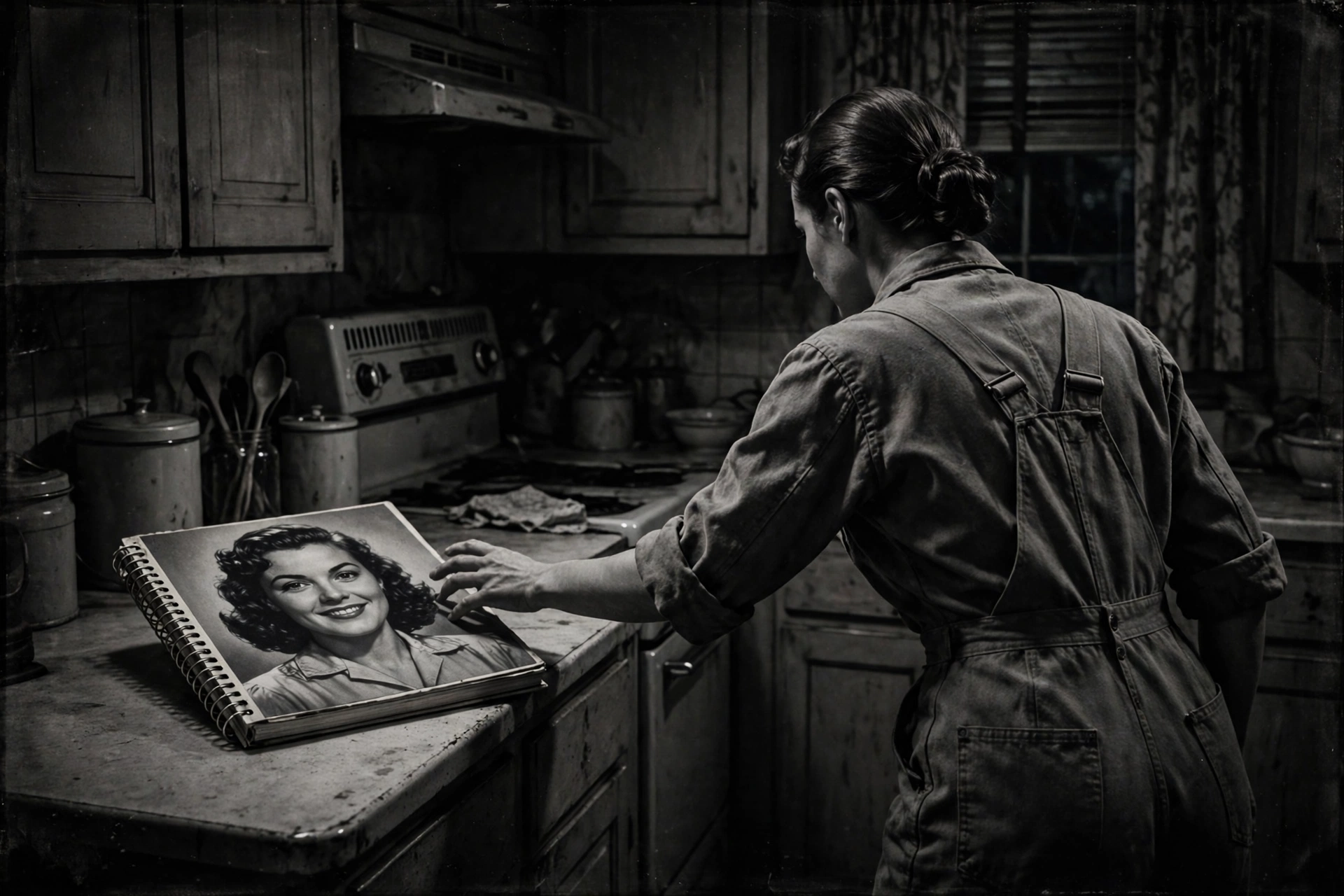
I am writing this in a hurry, one eye on the hallway, because the moment he remembers my phone exists he will come for it. The kitchen stinks of tinned chicken. Sinatra crackles from the radio in the hall, and my husband is singing along in a voice that is not quite his own. Something cold is breathing on the back of my neck. The necklace I never put on is strangling me. If a cookbook ever lands on your porch, burn it. Do not read it. Burn it.
It started last Friday. The maple out front had gone scarlet and gold, leaves ankle-deep across the lawn. Ralph finished work early and turned up with wine and a cheesecake, because Friday belonged to the two of us and a film. Six years married, and we mostly lived in separate orbits. He was the dreamer. I was the one with grease under her fingernails.
I mend tyres all day, the only woman on the shop floor, and most evenings I am under somebody else's bonnet anyway, fixing cars for whatever the parts cost. I learned on old motors, mostly the ones built before 2010, from videos, from getting it wrong, from wandering the scrapyard. Ralph, meanwhile, studied money and hated it, came from a long line of policemen, and collected hobbies the way other people collect stamps. Painting, then sculpture, then podcasts, then film. He would abandon each one and destroy every trace of it.
That Friday I nearly fell over a parcel on the step. Brown paper, string, no name, no address anywhere on it. I held it to my ear and gave it a shake. I expected some broken gadget somebody had dumped on us, a dead games console or a tape deck, the sort of thing that keeps me up half the night hunting down repair manuals. It made no sound at all.
Ralph just grinned. Somebody likes us, he said. A present. I told him the holidays were months away. He said maybe a driver I had helped was saying thanks. Fair enough. I ripped the paper away and laughed out loud. A cookbook, spiral-bound, with a cheerful dark-haired woman on the front, pearls cinched tight at her throat, a scarlet mouth, a swirling patterned backdrop. The Happy Homemaker's Cookbook, it said. Nineteen fifty-two, according to the page inside.
We both laughed. I opened it and read the first page aloud in my best grand-dame voice, all vowels and drama. The war was over, the women were home from the factories, the men were starving, and here were thirty-five dishes her little ones begged for and her husband devoured. Ralph roared, his eyes bright green. "I would never trade you," he said, "not even for a wife who can cook." I punched his arm, maybe too hard. "I can cook when I put my mind to it." "Sure," he said, "and I can swap a tyre." "Watch me," I said.
The pages felt brand new, white and stiff, not seventy years old at all. I picked the simplest thing I could find, cheese melted over toast, and went to the shop for the ingredients. And it worked. It was genuinely delicious, which stunned me, because I had always believed cooking was a talent I simply did not have. We ate cake, drank wine, and went to bed happy. But all night I woke thinking I could hear a woman's heels tapping in the corridor, and the bedroom was full of the smell of heavy old perfume, the kind my grandmother wore. I do not own perfume. I have not for years.
In the morning Ralph woke holding his skull, his face red, looking at me like a shy stranger. He said my tracksuit bottoms were sloppy, then stopped himself halfway through the sentence. His eyes were flat. He had suffered terrible dreams, he said, but would not say what they were, and he went back to bed with a headache. I spent the day underneath my brother's ancient four-by-four, wrestling with the front suspension, two doors already replaced. When evening came I found Ralph in the armchair by the window, sipping a martini. I never knew we owned the glasses, let alone the olives. "Look at the state of you," he said. No smile. "You need proper clothes. What are we eating?"
I said I was thinking of ordering in. He rose slowly, sleeves rolled up, and suddenly he seemed taller, his voice dropped an octave. What I had suggested, he said, was unacceptable. He pressed the cookbook into my hands like a manager handing a trainee the manual for the tenth time. A wife cooks, he told me. That is what a wife is for. The book said so, page after page: food on the table at five, no excuses. I stood there grinding my teeth, then found a recipe for a tuna bake and decided to give him exactly what he had asked for, after a fashion.
I destroyed it on purpose. Two onions hacked to pieces, a box of pasta snapped up, five tins of fish emptied into a glass dish, the oven as hot as it would go. I left it in until the alarm screamed and smoke rolled across the ceiling, then slopped a lump onto a plate and buried it in pepper. He ate the whole thing. But his eyes had changed. Something cold glittered in them while his teeth ground on uncooked pasta. "Edith would not have made it like this," he said, and left the room, spine rigid, eyes fixed on nothing, the book under his arm.
I stood in the ruined kitchen, numb, with the stink of scorched fish still hanging in the air, and decided I could not sleep there. I went to my brother's and took the spare bed. I told myself it was a joke, a performance, a strange way of pushing me away. But I could not say why. The spare room was full of soft toys. I hugged a little giraffe with a mane of orange wool. The second my eyes closed, I heard heels on the floorboards and a woman laughing gently. I could not move. Something icy tightened around my neck. I woke clawing at my own face, my thumb smeared with red paste. Not blood. Lipstick. The giraffe was down by the footboard, ripped open, its stuffing everywhere.
Back home the perfume was so strong it made my eyes water. The television was gone, and in its place stood a huge old wooden wireless. I ran to the bedroom. The wardrobe stood open and everything of mine was gone. Overalls, shirts, jeans, all of it replaced with patterned frocks. Ralph sat at the table with his head in his hands, the cookbook spread open. Then the heels again, and the laugh. I grabbed for the book. He shrieked, a sound no human throat should make, and threw himself out of his chair, catching my shoulder and ripping my sleeve away from the seam.
I knew then it was not him. Whatever I had loved for six years was gone, and something else was wearing his skin. I bolted for the kitchen, tore the pages out of the book and crammed them into the waste disposal. He seized my shoulders and dragged me back, my feet skidding over the tiles, then spun me and set me on the countertop like a dancer. His mouth was at my ear. The police would never believe me, he breathed. Fish the book out and cook. The pearls were at my throat again, cold little stones sinking into my skin, tighter every time I pulled.
I gave in. A casserole, I said, done properly, and a whiskey for him. He let go, almost relieved, and went back to the living room with his drink. And here I am now, measuring out the ingredients from a page I pulled from the disposal. Tinned chicken, chopped celery, milk, frozen peas, tinned soup. In the shine of the cooker top I can see her behind me, the dark-haired woman from the cover. Edith.
I pick up the glass measuring jug and smash it on the worktop. It bursts into sharp glittering pieces, and I push them one by one into the soft flesh of the bake. Then I slide the dish into the oven, my heart hammering against my ribs, and shout that dinner will be on the table in twenty minutes. There is no answer. Only Sinatra, still playing in the next room, still singing that everything is permitted now.
Never miss a nightmare
One new horror story in your inbox, every Tuesday and Friday. Plus the free Red Room e-book — three brutal originals, subscribers only. No spam, unsubscribe anytime.
One story every Tuesday and Friday — unsubscribe anytime. We store your email only to send you the newsletter. See our Privacy Policy.
Keep reading… if you dare
Browse more horror
Best horror stories Short scary stories Free scary stories True scary stories Creepypasta stories Best ghost stories Stories to tell in the dark Psychological horror Two-sentence horror